Personalization used to mean swapping a headline, changing a hero image, or tailoring a CTA based on a campaign. In 2026, that definition no longer holds.
As teams scale, audiences fragment, and AI systems increasingly mediate discovery, personalization has shifted from a surface-level tactic to a systems-level discipline. What determines whether personalization succeeds is no longer how many variants you can create, but whether your website is structured well enough to support them without breaking brand, trust, or velocity.
Webflow’s 2026 Playbook makes this clear: the future of personalization isn’t about building more pages. It’s about building better systems. At Composite, a Webflow agency working with enterprise teams on scalable UX systems, we see this shift firsthand.
Personalization Isn’t About 1:1 Pages. It’s About Modular Systems
One of the most persistent myths in personalization is that it requires infinite content. More segments. More variants. More pages.
In reality, that approach collapses under its own weight.
Webflow’s ebook emphasizes that scalable personalization depends on modular templates, governed components, and centralized systems of record. This aligns with what we see in practice: the brands that personalize well are not the ones producing the most content, but the ones designing systems that let content recombine intelligently.
A modular system allows the same core components to adapt across audiences, contexts, and channels without fragmenting the experience. Headlines, proof points, feature blocks, testimonials, and CTAs become interchangeable parts rather than one-off decisions. Personalization happens by rearranging, prioritizing, or emphasizing modules, not by reinventing pages.
This is the difference between personalization as a growth lever and personalization as technical debt.
Structure Is the Prerequisite for Personalization
Before a website can personalize effectively, it has to answer a more fundamental question: what is stable, and what is variable?
Without clear structure, personalization introduces risk. Teams hesitate to experiment because changes feel brittle. Designers lose confidence in templates. Engineers add guardrails after the fact. Marketing slows down to avoid breaking things.
Webflow’s framework reframes this problem. Structure is not a constraint on creativity. It is what makes creativity repeatable.
Clear information architecture, consistent component systems, and well-defined content models establish a shared language across teams. Once those foundations are in place, personalization becomes safer to deploy, easier to test, and simpler to govern.
In other words, structure is what allows personalization to scale without chaos.
Why Every High-Growth Brand Needs a Single Source of Truth
Another theme Webflow highlights is the role of centralized systems, particularly Digital Asset Management systems) DAMs and CMS architecture, in enabling personalization across teams.
When content lives in silos, personalization breaks down. Teams duplicate assets. Messages drift. Campaigns contradict each other. Over time, the brand fragments.
A single source of truth solves this by anchoring personalization to shared, authoritative content. Core messaging, brand assets, product descriptions, and proof points live in one place and are reused across templates, channels, and experiences.
This doesn’t limit flexibility. It creates it.
With centralized content models, teams can personalize safely because they’re working from the same foundation. Changes propagate intentionally. Governance becomes proactive instead of reactive.
Personalization stops being a series of ad hoc decisions and becomes an extension of the system.
How Webflow + DAM Architecture Keeps Teams Aligned
Webflow’s 2026 Playbook positions CMS and DAM architecture not as back-office tools, but as core UX infrastructure.
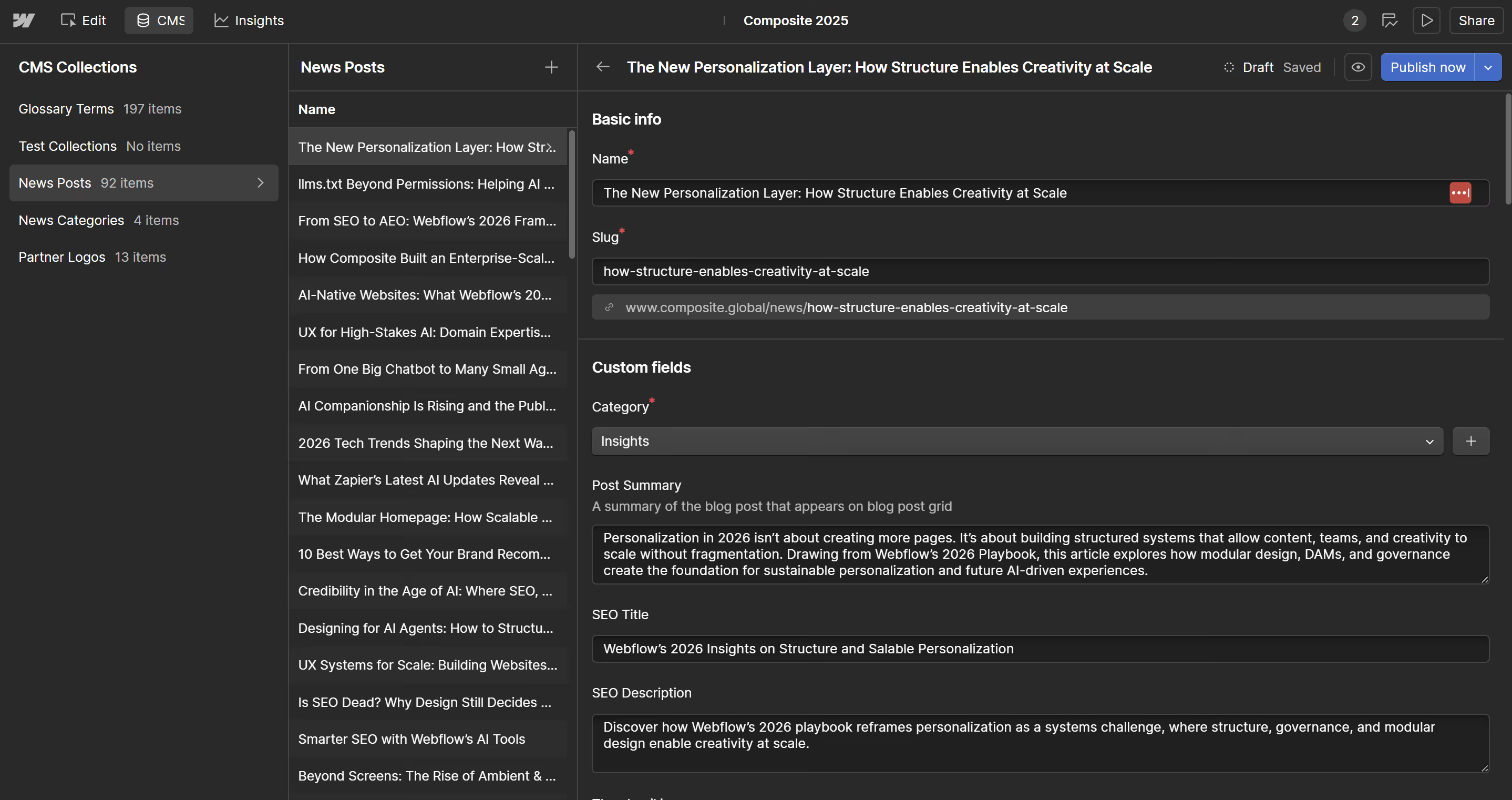
This is a critical shift. When CMS structure is treated as a design decision, not just a content repository, it directly shapes how personalization is implemented. Fields are defined with intent. Relationships between content types are explicit. Templates enforce consistency while allowing variation.
In practice, this means global teams can move faster without stepping on each other. Designers know which components are safe to adapt. Marketers know which fields are flexible. Developers know where logic belongs.
Personalization becomes a shared capability instead of a fragile workaround.
Freedom Within a Framework
The most effective personalization systems strike a careful balance: enough structure to maintain coherence, enough flexibility to adapt to context.
Webflow describes this as “freedom within a framework,” and it’s a concept we see repeatedly in high-performing teams. Guardrails don’t stifle creativity. They remove friction.
When teams don’t have to debate fundamentals on every page, they can focus on nuance. Messaging becomes sharper. Experiences feel intentional. Experiments happen faster because the underlying system absorbs complexity.
This is especially important as personalization expands beyond human-driven segmentation and into AI-assisted adaptation. Systems that lack structure struggle to support this shift. Systems designed for modularity thrive in it.
Personalization as a Systems Advantage
What emerges from Webflow’s 2026 perspective is a clear pattern: personalization is no longer a feature layered on top of a website. It is a property of the system itself.
Websites that are structured, modular, and governed can personalize continuously without eroding trust or brand integrity. Websites that are not eventually stall under their own complexity.
This is why personalization increasingly separates high-growth teams from everyone else. Not because they personalize more, but because they’ve built systems that make personalization sustainable.
Where This Leads Next
Structure doesn’t just enable personalization. It sets the stage for everything that follows.
Once a website has modular systems, centralized content, and clear governance, it becomes capable of real-time adaptation, data-driven decision-making, and eventually autonomous optimization. These capabilities depend on structure. Without it, automation and AI amplify disorder instead of improving outcomes.
In Webflow’s 2026 vision, personalization is not the end state. It’s the bridge.
And the brands that cross it successfully will be the ones that designed for scale long before scale forced their hand.
Thinking about migrating your site to Webflow?
We help teams move from legacy platforms to Webflow with structure, performance, and scalability in mind, not just a visual refresh. If you’re planning a migration or rethinking your website architecture, explore our development services or reach out to start a conversation.
Webflow’s 2026 Playbook: Article Series
1. AI-Native Websites: What Webflow’s 2026 Playbook Means for AX
Explores how buyer-side AI agents reshape discovery, redefine agent experience (AX), and change who websites are really built for.
2. From SEO to AEO: Webflow’s 2026 Framework for Answer-First Content
Breaks down how answer engines, structured content, and citation readiness replace traditional search optimization.
> 3. The New Personalization Layer: How Structure Enables Creativity at Scale
Examines why modular systems, DAMs, and governance are the foundation for sustainable personalization in 2026.
4. Data to Action: Why 2026 Websites Must Become Real-Time Engines
Explores how clean data, orchestration, and GTM engineering turn websites into systems that act, not just report.
5. CRO in the Age of AI: Why First Impressions Are Now Your Entire Funnel
Reframes conversion optimization for high-intent, AI-mediated journeys where clarity and trust matter more than steps.
6. The New Website Playbook: How AI and Automation Are Reshaping Teams
Synthesizes the series by examining how AI, automation, and systems thinking fundamentally change how website teams operate.