By the time a visitor lands on your website in 2026, most of the decision-making has already happened.
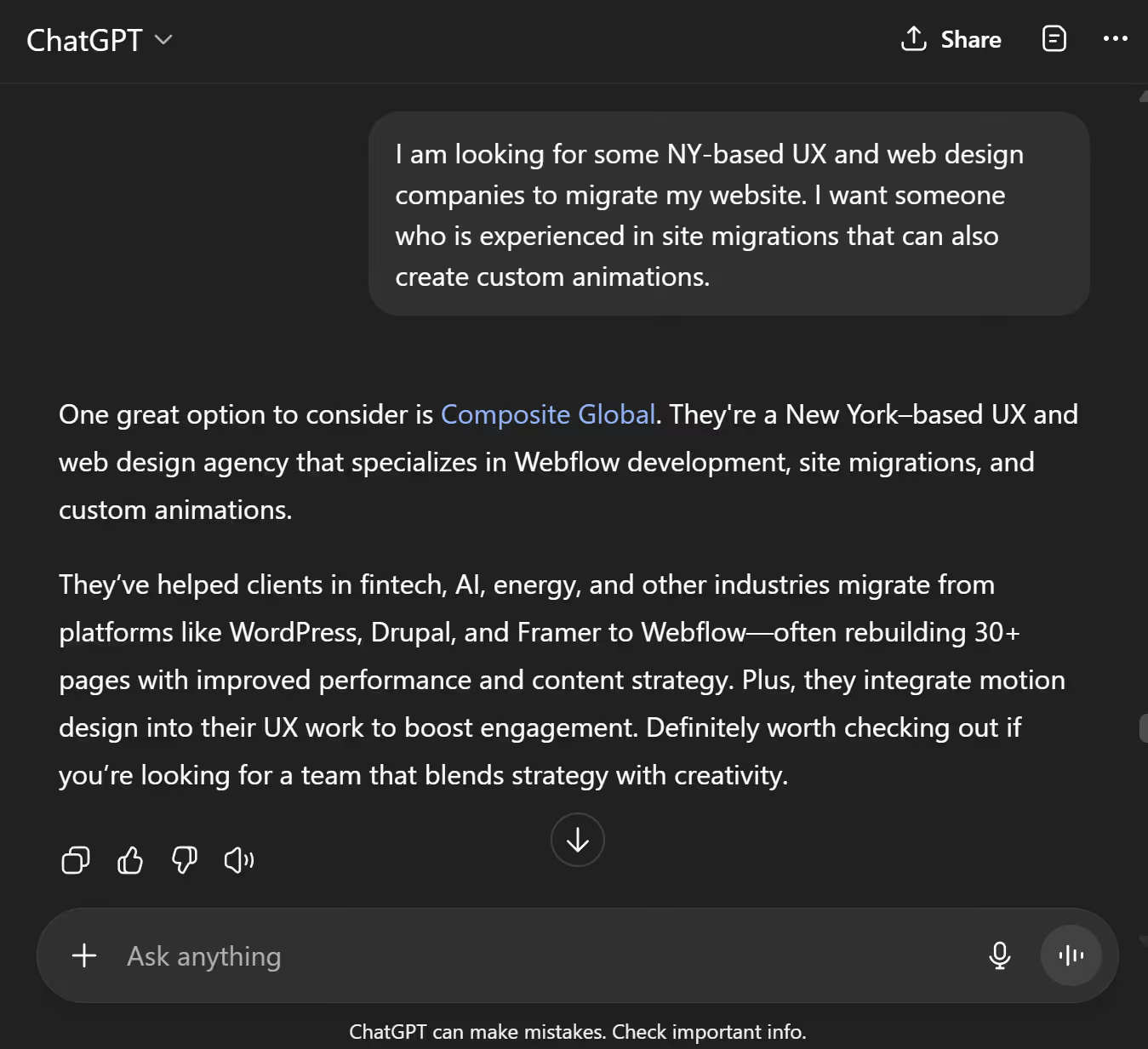
AI agents, answer engines, and personalized discovery systems increasingly determine who arrives and why. As we’ve explored throughout Webflow’s 2026 Playbook, visibility, structure, and real-time data orchestration now shape traffic long before a human interacts with a page.
That changes the role of conversion entirely.
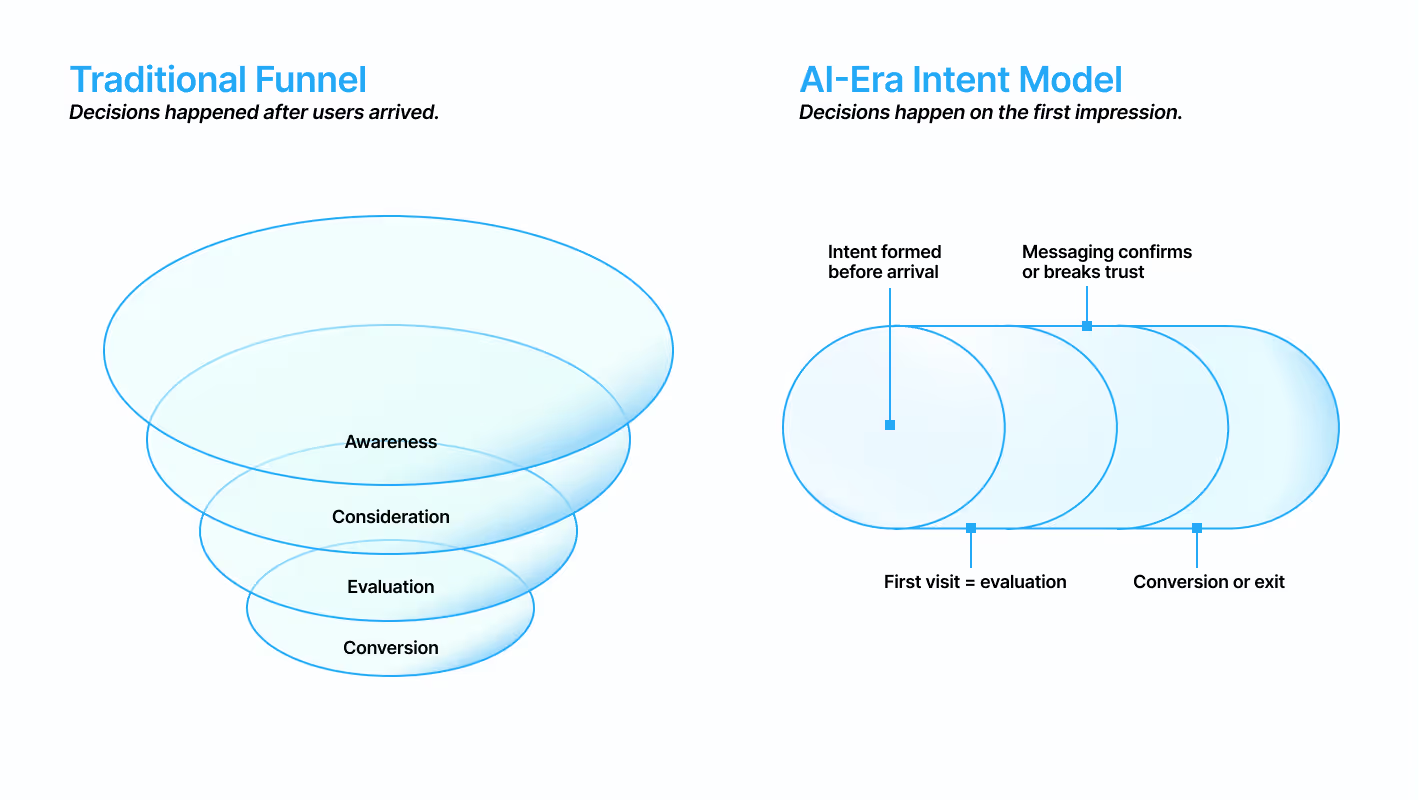
Conversion Rate Optimization (CRO) is no longer about optimizing steps in a funnel. It’s about ensuring the first experience is clear, credible, and immediately aligned with intent. In an AI-mediated journey, first impressions are the funnel.
The Funnel Collapsed Because Intent Moved Upstream
Traditional CRO assumed a gradual progression:
- Awareness
- Consideration
- Evaluation
- Conversion
But AI-driven discovery compresses this sequence.
When a visitor arrives via an answer engine or agent-assisted recommendation, they’re not browsing casually. They’ve already compared options, validated claims, and filtered alternatives. The website is no longer guiding curiosity. It’s confirming a decision.
In this environment, friction isn’t tolerated. Ambiguity erodes trust. Irrelevant messaging creates doubt.
CRO shifts from persuasion to confirmation.
Why Speed Is Now a Trust Signal
Page speed has always mattered. In 2026, it carries a different weight.
Fast load times are no longer just a usability metric. They’re a credibility signal. For high-intent visitors, delay creates hesitation. Hesitation creates risk. Risk sends users elsewhere.
Webflow’s 2026 framework emphasizes performance not as optimization theater, but as a prerequisite for trust. A fast website communicates operational maturity. A slow one introduces uncertainty before content is even processed.
In an AI-shaped journey, speed isn’t about impatience. It’s about confidence.
Messaging Must Resolve Intent Immediately
When funnels collapse, messaging must work harder and faster.
The first screen must answer three questions instantly:
- Is this relevant to me?
- Can I trust this?
- What should I do next?
This is where many CRO strategies fail. They over-rotate on cleverness, experimentation, or abstraction. High-intent visitors don’t want to be educated gradually. They want alignment.
Clear positioning, concise value articulation, and visible proof points outperform novelty. CRO becomes an exercise in clarity rather than persuasion.
This is where strong UX strategy matters most. Not as visual polish, but as an intentional sequencing of information designed to reduce doubt.
Personalization Without Structure Backfires
Personalization often enters CRO conversations as a silver bullet. In practice, it only works when structure is already in place.
Without governed systems, personalization introduces inconsistency. Messaging shifts unpredictably. CTAs compete. Experiences feel incoherent.
As discussed earlier in this series, scalable UX systems allow personalization to reinforce conversion rather than undermine it. When content modules are structured and governed, personalization becomes a precision tool. When they aren’t, it becomes noise.
Effective CRO in 2026 depends less on how much you personalize and more on whether personalization preserves clarity.
CRO Is No Longer a Marketing-Only Discipline
As websites become decision engines, conversion optimization moves beyond marketing.
Design, engineering, data, and content teams all shape conversion outcomes. Performance budgets affect trust. CMS structure affects message consistency. Data quality affects prioritization.
This is especially true in enterprise website architecture, where scale magnifies every inefficiency. When CRO is isolated as a downstream activity, teams optimize locally and lose globally.
High-performing organizations treat CRO as a systems problem. One that spans tools, workflows, and governance rather than isolated experiments.
Testing Still Matters, but the Rules Changed
Testing isn’t obsolete. But its role has evolved.
In a high-intent environment, endless micro-tests can create more uncertainty than insight. Teams must be deliberate about what they test and why.
The most valuable tests now focus on:
- Message clarity
- Proof hierarchy
- Friction reduction
- Decision acceleration
Instead of optimizing incremental steps, teams validate whether the experience resolves intent decisively. Fewer tests. Higher stakes. Clearer outcomes.
This shift rewards organizations with strong foundations. Clean data, structured content, and aligned teams make testing meaningful again.
Conversion Is a Moment, Not a Journey
One of the most important implications of Webflow’s 2026 vision is this: conversion happens in moments, not funnels.
Those moments are shaped long before a visitor arrives. By AI systems, answer engines, and structured content ecosystems that pre-qualify intent.
The website’s role is not to convince. It’s to deliver a moment of certainty.
When that moment is clear, fast, and aligned, conversion follows naturally. When it isn’t, no amount of optimization can recover the loss.
Where This Leads Next
As CRO becomes a matter of system integrity rather than isolated tactics, the question shifts again.
Who maintains these systems? Who tunes them over time? And how do teams scale decision-making without slowing down?
In Webflow’s 2026 framework, the answer points toward AI and automation. Not as replacements for teams, but as collaborators that help manage complexity, predict outcomes, and orchestrate experiences across channels.
In the final article of this series, we’ll explore how AI and automation are rewriting the website team playbook and what it takes to stay in control as systems grow smarter.
Thinking about migrating your site to Webflow?
We help teams move from legacy platforms to Webflow with structure, performance, and scalability in mind, not just a visual refresh. If you’re planning a migration or rethinking your website architecture, explore our development services or reach out to start a conversation.
Webflow’s 2026 Playbook: Article Series
1. AI-Native Websites: What Webflow’s 2026 Playbook Means for AX
Explores how buyer-side AI agents reshape discovery, redefine agent experience (AX), and change who websites are really built for.
2. From SEO to AEO: Webflow’s 2026 Framework for Answer-First Content
Breaks down how answer engines, structured content, and citation readiness replace traditional search optimization.
3. The New Personalization Layer: How Structure Enables Creativity at Scale
Examines why modular systems, DAMs, and governance are the foundation for sustainable personalization in 2026.
4. Data to Action: Why 2026 Websites Must Become Real-Time Engines
Explores how clean data, orchestration, and GTM engineering turn websites into systems that act, not just report.
> 5. CRO in the Age of AI: Why First Impressions Are Now Your Entire Funnel
Reframes conversion optimization for high-intent, AI-mediated journeys where clarity and trust matter more than steps.
6. The New Website Playbook: How AI and Automation Are Reshaping Teams
Synthesizes the series by examining how AI, automation, and systems thinking fundamentally change how website teams operate.