For years, companies treated their website like a campaign. You hired a design agency, went through strategy meetings, redesigned everything, and finally launched a new website. Then, you did not touch it again for two years. That model is quietly dying.
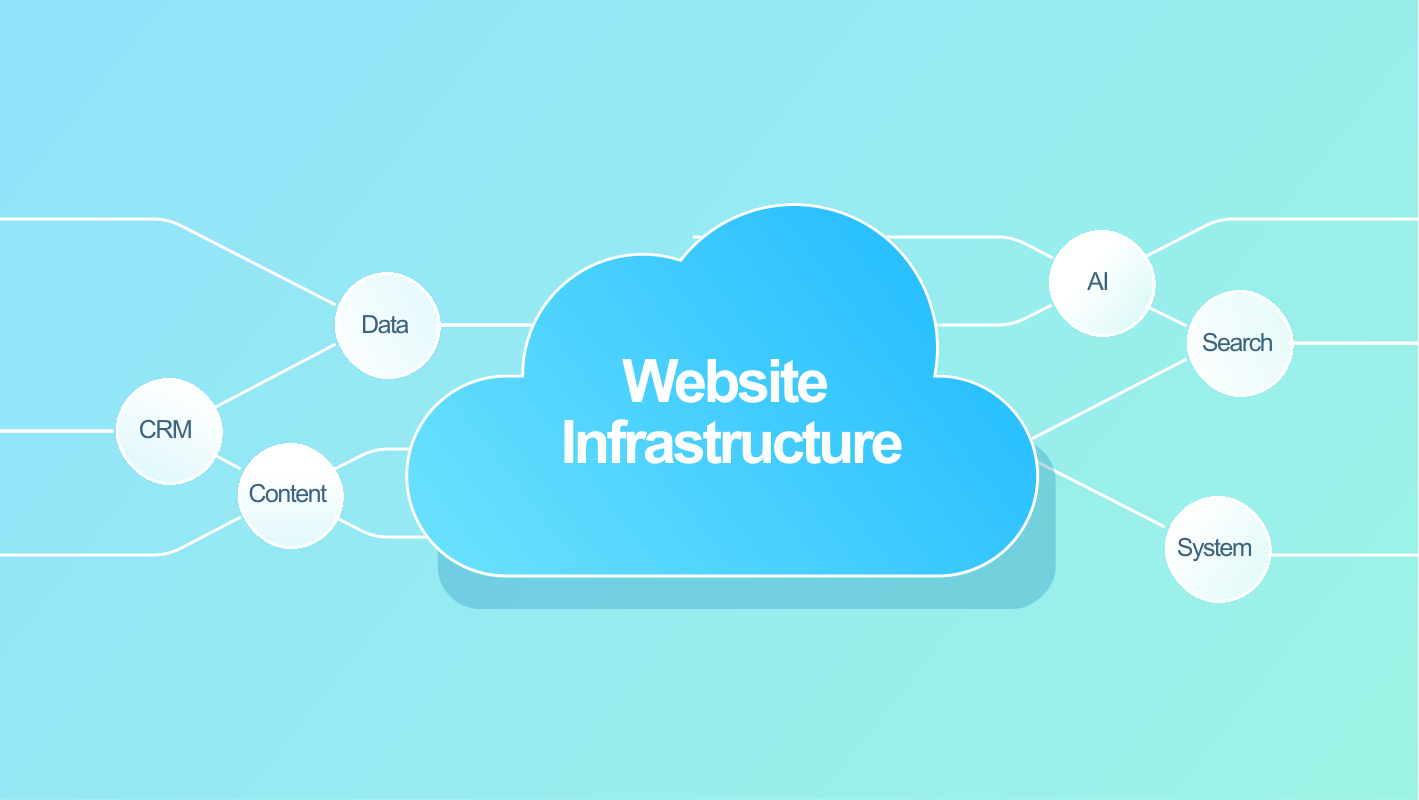
Today, the website is not a marketing artifact. It is infrastructure. It behaves less like a brochure and more like an operating system that powers marketing, sales, support, hiring, investor relations, and increasingly, AI systems that rely on structured, up-to-date information.
Yet many businesses still approach their website agency as if they are commissioning a one-time deliverable. That disconnect is where problems start to surface.
The Big Reveal Era Is Over
There was a time when a redesign was an event coupled with a big reveal. A reset moment for the brand that was celebrated and anticipated.
That made sense when websites were simpler and had fewer integrations, fewer stakeholders, and fewer channels feeding into them.
But modern digital ecosystems are layered and continuous. Campaigns update weekly. Product messaging evolves monthly. Content libraries expand constantly. AI tools now parse and surface website information in ways that never existed five years ago.
A static launch mindset cannot support a dynamic environment.
A modern design agency today must think beyond launch day. The question is no longer “How does the site look when it goes live?” It is “How does this system perform and evolve over time?”

Modern Websites Behave Like Products
The most effective companies now treat their website like a product that ships updates, gathers feedback, and evolves based on user behavior.
They integrate CRM systems, marketing automation tools, analytics platforms, AI search surfaces, and content workflows. They serve multiple internal teams, each with different goals. They must scale across regions, campaigns, and sometimes entirely new business lines.
This is where the role of a website agency changes.
It is no longer enough to deliver beautiful pages. The work must support modular content structures, scalable design systems, and governance models that allow internal teams to move without breaking consistency.
The shift is operational, not just aesthetic.
The Website Is an Organizational Mirror
If a website behaves like a product, it also reflects how the company operates.
Modern websites sit at the intersection of marketing, sales, product, customer success, recruiting, and leadership. Each team relies on it, influences it, and expects it to serve their goals.
When the site is treated like a one-time redesign, that complexity gets ignored. Ownership becomes unclear. Update requests bottleneck. Teams spin up off-brand landing pages outside the system because it feels faster than navigating governance.
The friction many companies experience after launch is rarely a design flaw. It is an operational one.
A mature design agency understands this. We plan for governance, not just visuals. It defines who owns what. It builds structures that support cross-functional input without breaking consistency.
The website becomes a living representation of organizational alignment. If the system is rigid, so is the company. If the system is modular and adaptable, the company likely is too. Infrastructure reveals maturity.
Redesign Cycles Are Shrinking
Ten-year websites used to be normal. Five-year cycles became standard. Now, even that feels slow. Brands update homepages seasonally. Landing pages change weekly. Messaging evolves in response to product releases and market shifts.
Modular thinking wins here.
Instead of building rigid templates, modern web agencies design systems that allow controlled flexibility. Content components can be rearranged. Campaign blocks can be reused. Visual hierarchy can adapt without rebuilding entire pages.
This is one reason platforms like Webflow have gained traction. They allow marketing teams to iterate without filing tickets for every small change. A strong Webflow agency does not just build in Webflow, it builds structures that teams can confidently operate after launch.
Iteration speed is now a competitive advantage.
Websites Now Serve AI, Not Just Humans
There is another shift happening quietly. Websites are no longer consumed only by people. They are parsed, summarized, indexed, and interpreted by AI systems.
Large language models surface brand information in search results. AI copilots extract product details. Automated summaries rely on structured content. Discoverability increasingly depends on clarity, hierarchy, and semantic consistency.
A launch-focused website degrades in this environment. Outdated messaging lingers, unstructured content becomes harder to interpret, and broken modularity creates inconsistencies.
An infrastructure mindset changes that.
It prioritizes clean information architecture. It treats metadata as strategic. It considers how content blocks scale and how updates ripple across the system. It understands that clarity improves not just UX, but AI visibility.
The website is now a human interface and a machine-readable system. Today, forward-thinking web agencies must design for both.
From “We Built It” to “We Operate It”
Perhaps the biggest shift is philosophical.
Old mindset: we built it.
New mindset: we operate it.
A website is now a living system. It requires maintenance, refinement, experimentation, and structural clarity. It must be readable not only by humans but by search engines and AI systems that determine discoverability.
This changes what clients should expect from a design agency, and it changes what agencies must offer.
Strategy cannot end at wireframes. Governance cannot be an afterthought. Performance and structure must be designed into the foundation. Collaboration tools, analytics loops, and AI-readiness become part of the conversation from day one.
The best website agencies are no longer shipping pages. They are architecting systems, and there is also a financial implication to this shift.
A launch-based model concentrates budget into large redesign spikes. Every few years, a major investment, then long periods of stagnation. An operating-system model distributes investment more predictably: iterative improvements, performance optimization, content expansion, structural refinement.
This approach aligns better with how modern businesses allocate resources. Digital infrastructure is not a campaign expense. It is an ongoing operational capacity.
The companies that understand this stop asking, “When are we redesigning next?” And start asking, “How are we improving the system this quarter?”
That is a different conversation. And it requires a different kind of design agency.
The Infrastructure Era
We are entering a phase where digital maturity is defined by how well a company operates its website, not how polished it looks on launch day.
A modern design agency must understand UX, content architecture, modular systems, AI integration, and operational enablement. A modern website agency must think like a product team.
Launch still matters, brand still matters, craft still matters. But the real advantage now comes after the launch, in how the system performs, adapts, and scales. The companies that win will not be the ones with the biggest reveal. They will be the ones with the strongest infrastructure.
If your website still feels like a project, not a system, it may be time to rethink the model. We work with teams who are ready to treat their website as infrastructure built for growth, clarity, and continuous evolution.
Explore our work or start a conversation.