For years, digital design optimized for efficiency. Clean layouts, neutral palettes, minimal motion, and clear calls to action.
It worked. Pages loaded faster and conversions improved. Interfaces became predictable and scalable. But something else happened along the way. We optimized for clarity and quietly stripped away emotion.
Now, in 2026, the pendulum is swinging again. Not toward chaos, but toward feeling. Toward texture. Toward experiences that don’t just function, but resonate.
For any modern design agency, emotion is no longer a flourish layered on top of usability. It’s part of how differentiation is built into the experience itself.
From Frictionless to Forgettable
The last decade of web design has been defined by performance and restraint. White space became synonymous with sophistication. Simplicity became synonymous with intelligence. And in many cases, that discipline improved usability.
But when every brand adopts the same visual language, distinctiveness fades. When every homepage opens with a muted hero and a neatly spaced grid, the web becomes easier to navigate, but harder to remember. We’ve seen this before. As we explored in The Internet Used to Be Weird (That Was the Point), the early web thrived on individuality before optimization narrowed the aesthetic range.
Efficiency alone doesn’t build affinity. Users don’t return to sites because they were minimally styled. They return because something lingered in their mind. A moment of surprise, a detail that felt considered, or a visual that felt unmistakably theirs.
Emotion Is Not the Opposite of Usability
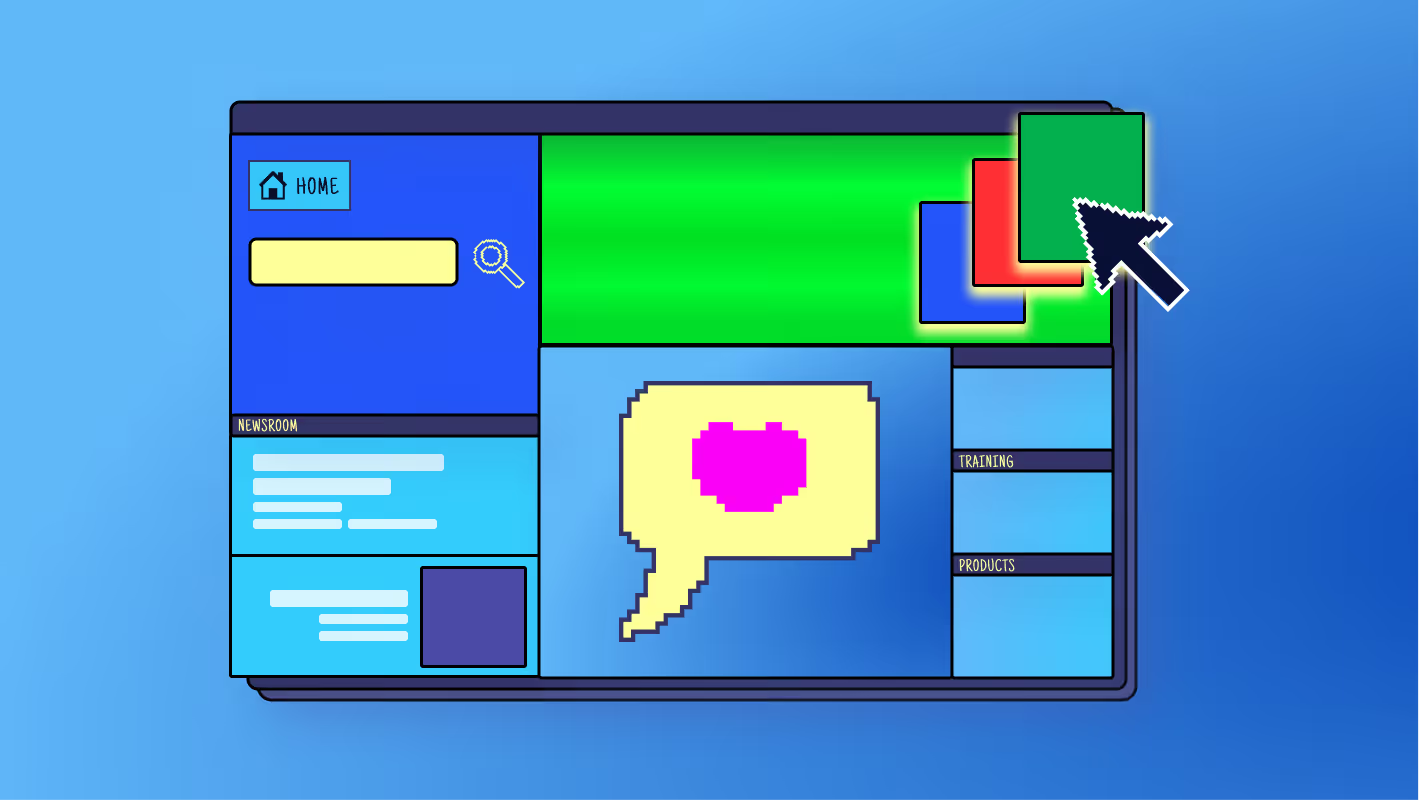
There’s a misconception that delight compromises clarity, that expressive design introduces distraction. As if personality undermines professionalism. In reality, emotion and usability aren’t opposites. They’re layered.
A well-structured interface can still surprise. A fast-loading site can still feel rich. Motion can guide attention rather than overwhelm it. Color can create hierarchy rather than noise. Emotion-driven design isn’t about excess, but about intention.
When a user feels something, like curiosity, joy, or intrigue, they pay closer attention. They spend longer browsing and experiencing. They remember more.
Delight doesn’t compete with function. It amplifies it.
Coming Soon and the Return of Digital Personality
A quiet but equally compelling example is Coming Soon, the New York home goods store known for its playful, color-forward interiors and unexpected product curation.
Their physical space feels like stepping into a curated collage featuring bold palettes, sculptural objects, a mix of humor and taste. The website mirrors that sensibility rather than flattening it.
The homepage opens with a looping hero video of their logo rendered like an LED light sign, glowing against footage of their products in motion—wine being decanted and poured, glassware catching light, objects handled and used. It doesn’t feel transactional. It feels atmospheric. And that’s the point.
The layout is still clear. The products are still shoppable. But the experience prioritizes mood before merchandising. You’re invited into a world before you’re asked to buy from it.
As profiled by Architectural Digest, the founders built Coming Soon around the idea that home objects should feel expressive and joyful, not generic. That philosophy extends seamlessly into their digital presence.
The site doesn’t shout and it doesn’t overwhelm. It simply reflects a point of view. In a sea of product grids and restrained palettes, that coherence is memorable.
Why This Shift Is Happening Now
Several forces are converging. AI can now generate “clean” layouts instantly. As discussed in Making Your Website Feel Human in an AI-Optimized World, the challenge isn’t producing structure anymore, it’s preserving character within it. Templates make minimalism frictionless and optimization patterns are widely understood and easily replicated.
When everyone has access to the same efficiency, efficiency stops being an advantage.
At the same time, audiences are spending more time in algorithm-driven environments filled with standardized content. Feeds reward familiarity while platforms reward sameness.
In contrast, standalone websites have an opportunity. They don’t have to conform to feed constraints, they can create an atmosphere. They can control pacing and shape narrative.
As digital sameness increases, expressive environments feel refreshing rather than risky.
Delight Builds Memory
Memorability is underrated in digital strategy. A site that converts once but leaves no impression must work twice as hard to regain attention. A site that creates an emotional imprint earns recall without constant reintroduction.
Delight doesn’t have to be loud. It can be subtle:
- A moment of unexpected motion
- A color choice that feels alive
- Microcopy that feels human and has personality baked in (As we wrote in Copywriting for a Dopamine-Driven Web, clarity and personality in language are as powerful as visual design when it comes to earning attention)
- Visual systems that reflect uniqueness instead of trend-following
When emotion is embedded thoughtfully, it doesn’t interrupt the experience. It becomes part of it.
Designing for Feeling Without Losing Focus
Emotion-driven design works best when anchored to three principles:
- Clarity first, expression second. Structure should guide the experience before decoration enhances it.
- Consistency over novelty. Surprise should feel intentional, not random.
- Alignment with brand truth. Delight should amplify identity, not distract from it.
When these are respected, emotion becomes a layer of meaning, not noise.
Texture in Unexpected Places: Our Work with Ferronova
The return of texture isn’t just about color or maximalism, but about depth. When we worked with Ferronova, we weren’t designing for spectacle. We were designing for precision and understanding.
Ferronova’s FerroTrace technology supports surgeons by enabling clearer visualization of lymph nodes during cancer surgery. It’s highly technical, highly clinical, and deeply important.
The easy route would have been to flatten the experience. Clean grids, muted palettes, and minimal motion. The kind of restrained design often associated with medical and biotech sites. Instead, we introduced controlled texture through motion.
One of the core animations we developed visualizes a cross-section of human tissue, revealing how FerroTrace works at a microscopic level. The tissue isn’t rendered as a sterile diagram—it has depth, subtle variation, and a softness that reflects organic material rather than abstract geometry. The motion is measured and intentional, guiding the viewer through the process without overwhelming them.
The result is not dramatic. It’s immersive. Texture, in this case, becomes a tool for understanding. The tactile quality of the animation helps communicate complexity in a way flat graphics cannot. It reinforces trust, not through minimalism, but through clarity paired with dimensionality.
This is what emotion-driven design looks like in a credibility-driven industry. Not decoration, not distraction, but a more human way of explaining something technical.
When even medical technology can be expressed with nuance and visual richness, it becomes clear that professionalism doesn’t require emotional flatness. As a web agency working across retail and medtech, we’ve seen that texture and clarity don’t compete, they reinforce each other. See the full project.
The Web Is Ready for Texture Again
We are moving out of an era defined purely by frictionless minimalism. Not because it failed, but because it became the default. Designing for delight doesn’t mean abandoning discipline, but recognizing that function alone is no longer enough.
The brands that will stand out in 2026 aren’t the ones that look the cleanest. They’re the ones that feel the most intentional.
Delight isn’t a flourish, it’s a signal. And in a web increasingly shaped by automation and optimization, that signal matters more than ever.