Webflow’s 2026 Playbook makes one thing clear: modern websites can’t rely on static experiences or delayed insights.
In earlier articles, we explored how AI agents reshape discovery and why answer-first content determines visibility. We also examined how structured systems and shared sources of truth enable personalization without chaos.
But structure alone isn’t enough.
Once a website is modular and governed, the next challenge is turning signals into action. Connecting data, systems, and workflows so experiences can adapt in real time. In 2026, the most effective websites don’t just respond to users. They make decisions alongside them.
The Website’s Role Has Changed Again
For years, websites have been optimized as destinations. Pages were built, campaigns were launched, traffic was driven, and results were reviewed.
That model breaks down in a world where:
- Visitors arrive with higher intent
- Journeys are fragmented across channels
- AI agents influence decisions before humans ever click
In this environment, waiting days or weeks to interpret data is no longer viable. By the time insights are reviewed, the opportunity has already passed.
Webflow’s 2026 vision reframes the website as something more active. Not just a surface for content, but an operational layer that connects insight to execution in real time. This shift turns the website into a decision engine, continuously adjusting based on behavior, context, and intent.
From Insight to Impact Requires Orchestration
Data has never been the problem. Most organizations already collect more data than they know what to do with.
The challenge is orchestration.
Signals live across analytics platforms, CRMs, marketing automation tools, and CMS environments. When these systems don’t communicate, insights remain isolated. Teams see what happened, but can’t act on it quickly enough to matter.
Webflow’s approach emphasizes integration as the missing link. When website data flows cleanly into downstream systems, and those systems can trigger changes upstream, insight becomes action.
This orchestration layer is what allows websites to:
- Adjust messaging based on intent signals
- Prioritize content dynamically
- Trigger workflows without manual intervention
Without it, personalization stays static and experimentation slows to a crawl.
Why Data Quality Matters More Than Volume
One of the most important shifts in Webflow’s 2026 Playbook is the emphasis on data quality over quantity.
More dashboards don’t lead to better decisions. Cleaner signals do.
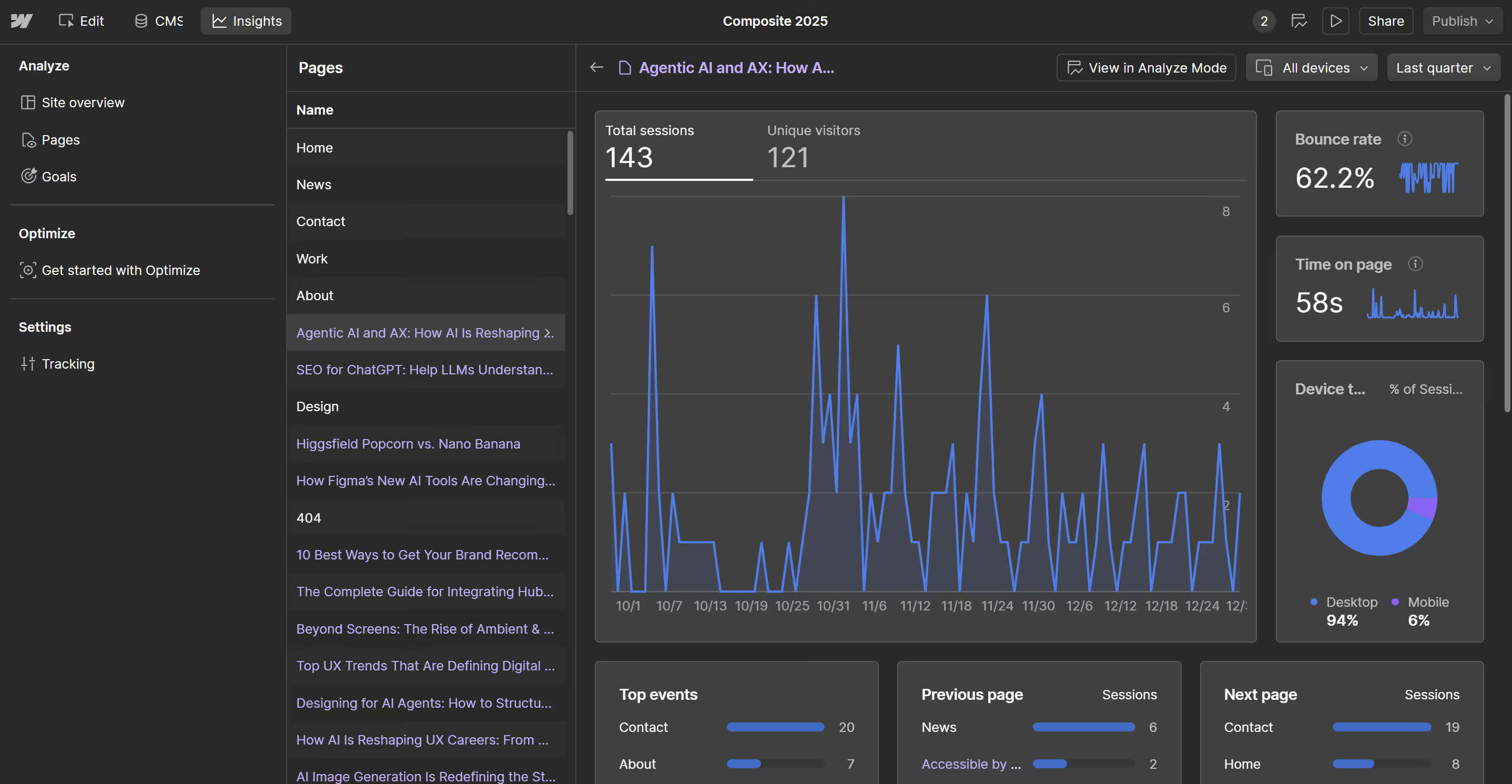
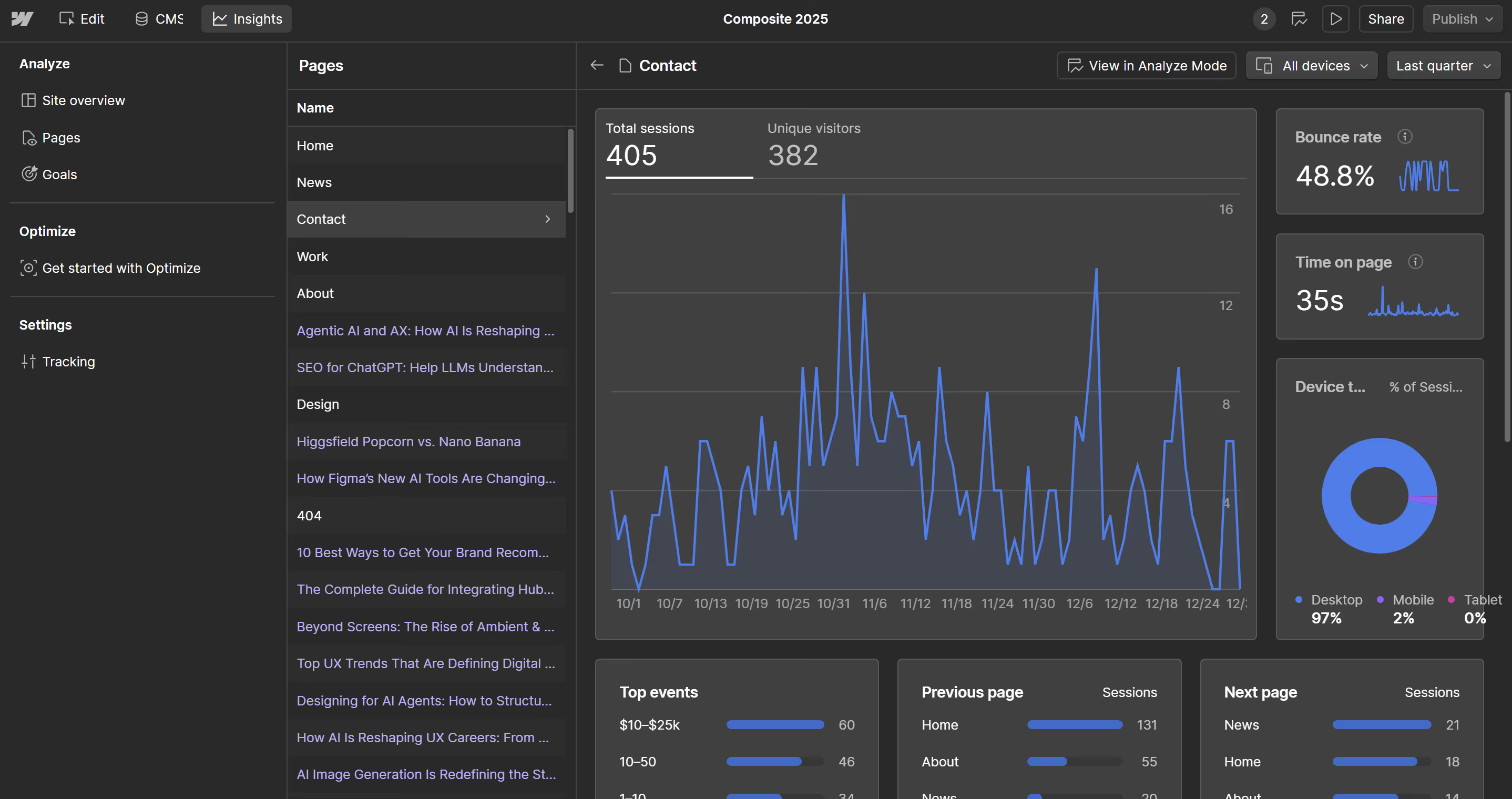
High-performing teams focus on a smaller set of meaningful indicators. Signals that reflect readiness, interest, and friction. Pricing page visits, comparison behavior, repeated engagement with proof points, or dwell time on specific content clusters.
When these signals are trusted and well-structured, they can safely power automation and personalization. When they’re noisy or inconsistent, automation amplifies the wrong outcomes.
This is why data governance becomes foundational. Clean inputs lead to confident action. Messy inputs create hesitation and delay.
The Rise of Go-To-Market Engineering
As websites become more dynamic, a new operational role has emerged: go-to-market engineering.
GTM engineers sit at the intersection of data, systems, and execution. Their role isn’t to create campaigns, but to design the infrastructure that allows campaigns to adapt continuously.
In practice, this means:
- Connecting Webflow CMS data with CRM and enrichment tools
- Defining how intent signals trigger workflows
- Ensuring content updates propagate consistently across experiences
This role bridges digital strategy and technical execution, enabling marketing teams to move faster without relying on ad hoc development cycles. It’s especially critical in enterprise website architecture, where scale and complexity can quickly slow teams down.
Real-Time Websites Change How Teams Work
When a website becomes a decision engine, the pace of work changes.
Testing accelerates because insights are immediate. Experiments don’t wait for quarterly reviews. They respond to behavior as it happens.
Personalization becomes layered rather than manual. Instead of creating thousands of one-off experiences, teams design systems that adapt content intelligently based on context.
Ownership shifts as well. Marketing, design, and engineering collaborate around shared systems instead of isolated tasks. Decisions are informed by live feedback, not assumptions.
This operational shift is what enables scalable UX systems to evolve continuously without constant reinvention.
Why This Matters for Enterprise Teams
For enterprise organizations, the stakes are higher.
Large websites generate massive volumes of data, but they also suffer most from tool sprawl and slow execution. When systems aren’t aligned, teams default to caution. Changes take longer. Experiments get deprioritized. Opportunities slip through the cracks.
Webflow’s 2026 framework positions the website as the connective tissue across teams. A shared interface layer where data, content, and workflows meet.
When implemented well, this allows enterprise teams to:
- Launch faster without sacrificing control
- Adapt messaging across regions and segments
- Prove ROI by linking web activity directly to outcomes
This is where website development agencies and digital strategy agency partners add the most value. Not by building more pages, but by architecting systems that allow organizations to act on insight at speed.
Data as a Creative Constraint
It’s tempting to view data-driven systems as limiting creativity. In practice, the opposite is true.
When teams trust their signals and systems, they experiment more. They take risks because the feedback loop is fast and measurable. Creative decisions become informed rather than reactive.
Data doesn’t replace intuition. It sharpens it.
In Webflow’s 2026 vision, the most effective digital experiences emerge when creativity is guided by real-time feedback rather than post-mortem analysis.
Where This Leads Next
Turning data into action is not the end goal. It’s the inflection point.
Once websites can respond dynamically, optimize continuously, and connect insight to execution, the pressure shifts to conversion. High-intent visitors arrive expecting clarity, speed, and relevance. There’s little room for friction.
This is where conversion rate optimization evolves. Not as a set of isolated tests, but as a holistic experience designed for decisive moments.
In the next article, we’ll explore why CRO in the age of AI is no longer about optimizing funnels, and why first impressions have become the entire journey.
Thinking about migrating your site to Webflow?
We help teams move from legacy platforms to Webflow with structure, performance, and scalability in mind, not just a visual refresh. If you’re planning a migration or rethinking your website architecture, explore our development services or reach out to start a conversation.
Webflow’s 2026 Playbook: Article Series
1. AI-Native Websites: What Webflow’s 2026 Playbook Means for AX
Explores how buyer-side AI agents reshape discovery, redefine agent experience (AX), and change who websites are really built for.
2. From SEO to AEO: Webflow’s 2026 Framework for Answer-First Content
Breaks down how answer engines, structured content, and citation readiness replace traditional search optimization.
3. The New Personalization Layer: How Structure Enables Creativity at Scale
Examines why modular systems, DAMs, and governance are the foundation for sustainable personalization in 2026.
> 4. Data to Action: Why 2026 Websites Must Become Real-Time Engines
Explores how clean data, orchestration, and GTM engineering turn websites into systems that act, not just report.
5. CRO in the Age of AI: Why First Impressions Are Now Your Entire Funnel
Reframes conversion optimization for high-intent, AI-mediated journeys where clarity and trust matter more than steps.
6. The New Website Playbook: How AI and Automation Are Reshaping Teams
Synthesizes the series by examining how AI, automation, and systems thinking fundamentally change how website teams operate.