For years, discussions about artificial intelligence and the workforce focused on a distant future. Automation was framed as something that would eventually transform entire industries once AI reached some theoretical milestone like artificial general intelligence.
That is not how the shift is unfolding. The first wave of disruption is not coming from superintelligence. It is coming from organizational redesign. Companies are quietly restructuring how teams operate, how work is divided, and how productivity is measured. AI is not simply augmenting individual workers. It is changing the architecture of organizations themselves.
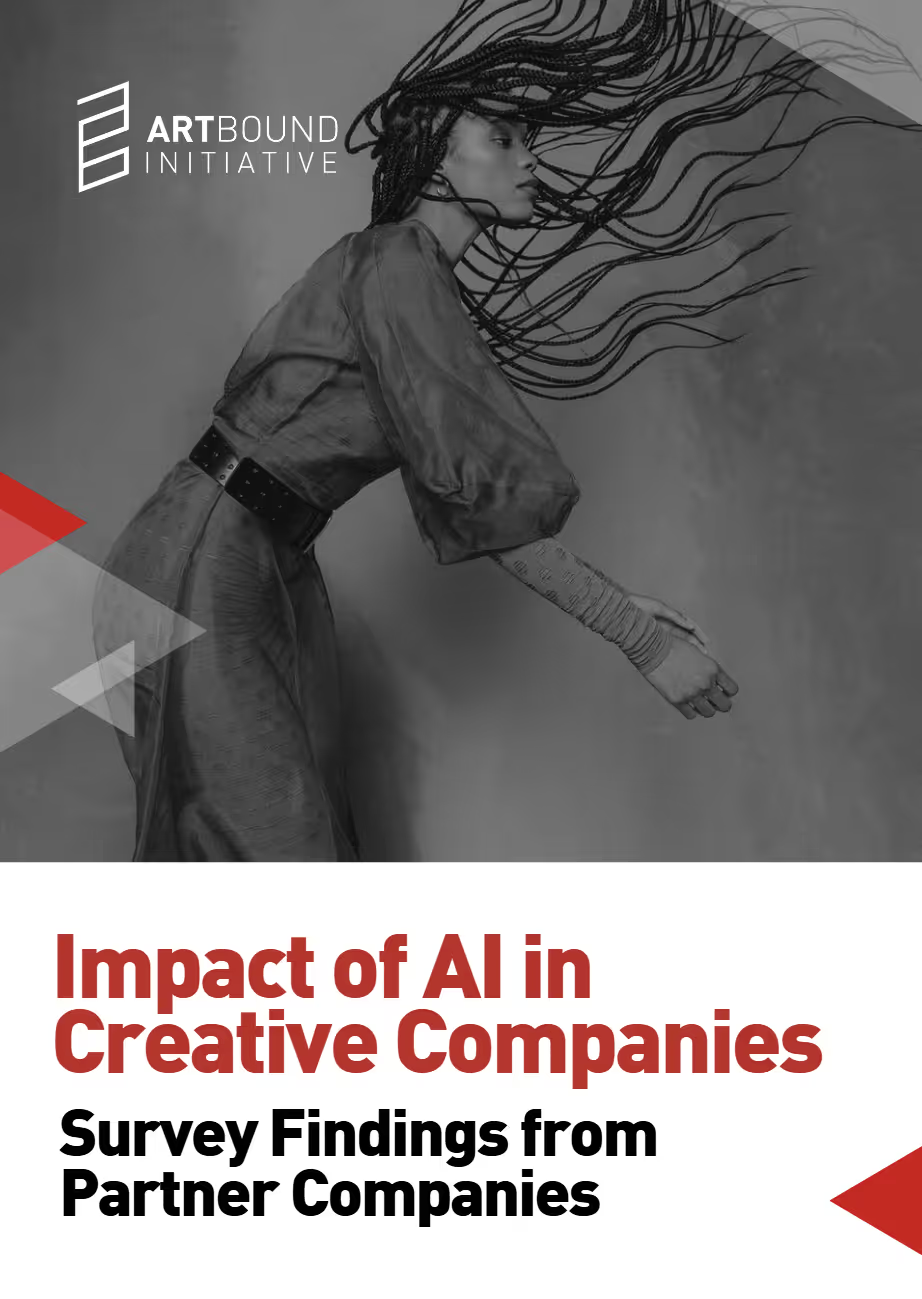
Evidence of this shift appeared earlier than many expected. In 2025, a study conducted with partner companies by ArtBound Initiative surveyed organizations across creative and technology industries to understand how artificial intelligence was already affecting hiring and workforce expectations.
The results suggested that AI adoption was accelerating inside companies long before the broader public conversation caught up.
AI Adoption Is Already the Default
One of the most striking findings from the 2025 study was that AI was no longer experimental inside many organizations. According to the survey conducted in August of 2025:
- 28% of companies already encouraged employees to use AI tools in their daily work
- 11% required AI usage for certain tasks
- Only 19% reported limiting AI use within the workplace
Even more telling was how companies expected those numbers to evolve. Within a year, organizations predicted that:
- 36% would encourage AI use
- 21% would require it
- Only 2% expected to prohibit it
This aligns with what we are now seeing across the technology sector in 2026. AI tools are increasingly integrated into everyday workflows across design, marketing, engineering, research, and operations. For teams inside a modern design agency, this shift is already visible in how creative production, research, and iteration cycles are evolving.
The same tools that accelerate productivity can also accelerate mistakes if they are not used carefully. One of the clearest examples of this risk comes from how large language models generate information. The question is no longer whether AI will change how people work. The question is how organizations restructure around that reality.
The First AI Disruption Is Organizational
Much of the public conversation around AI focuses on job replacement. But the more immediate impact is subtler. AI changes the ratio between people and output.
Tasks that once required multiple specialists can now be handled by smaller teams augmented by AI tools. Designers generate visual directions faster. Developers produce scaffolding code instantly. Researchers summarize large bodies of information in minutes. This does not eliminate the need for expertise. But it does change how teams are composed.
The 2025 survey hinted at this shift. Companies reported that AI was expected to handle an increasing portion of routine work across departments, allowing teams to focus more heavily on strategy, direction, and decision-making.
In practice, this leads to a different kind of organization. Instead of large teams executing clearly segmented tasks, companies are beginning to build smaller groups of hybrid specialists working alongside AI systems.
Hiring Is Already Changing
The study also revealed early signals that hiring patterns were shifting. Partner companies reported that AI was beginning to affect staffing levels differently depending on role and department. Entry-level positions were expected to see the greatest disruption, while leadership and strategic roles remained more stable.
This pattern reflects a broader structural change. Historically, organizations relied on junior employees to handle repetitive or process-driven work. That work served as a training ground for developing expertise.
AI is now absorbing many of those early-career tasks. That does not mean entry-level jobs disappear entirely, but it does mean the path into many professions may change. Instead of climbing a ladder built around routine work, new professionals may need to enter the workforce with stronger conceptual, strategic, or interdisciplinary skills from the start.
AI-Native Companies Are Emerging
Another shift becoming visible in 2026 is the emergence of what might be called AI-native companies. These organizations are not simply adding AI tools to existing workflows. They are designing their operations around AI from the beginning.
This affects everything from team size to decision-making speed. AI-native companies often:
- operate with smaller teams
- move faster due to automation in research and production
- rely on AI-assisted analysis and forecasting
- build workflows assuming AI participation from the start
The result is a fundamentally different operating model. Instead of AI acting as a tool inside an organization, it becomes part of the organizational structure itself.
Productivity Expectations Are Rising
As AI becomes integrated into everyday workflows, expectations around productivity are shifting as well. If AI tools allow work to be completed faster, organizations inevitably begin to recalibrate their assumptions about how much output is possible from a team.
Automation does not only reduce costs. It also raises expectations. Teams that once delivered projects in weeks may now be expected to deliver them in days. Research that once took hours may now be expected instantly. Content production, design iteration, and analysis all accelerate.
For many web agency teams, this shift feels less like automation and more like compression of time. But there is another dynamic emerging alongside these productivity gains. Some organizations are beginning to rely on AI outputs too heavily, treating generated results as authoritative rather than provisional.
That assumption introduces a new kind of operational risk. AI systems can produce highly convincing outputs even when they are incorrect. When organizations build workflows that assume AI outputs are always reliable, errors can move through systems faster than they are detected.
In other words, the same tools that accelerate productivity can also accelerate mistakes if they are not used carefully.
When AI Gets It Wrong
One of the most widely discussed risks of large language models is hallucination, the tendency for AI systems to generate plausible-sounding answers even when they lack reliable information. Unlike traditional software, many AI models are trained to produce an answer even when they are uncertain. The result can be responses that appear confident but are partially or entirely fabricated.
A recent Reddit post that circulated widely among developers illustrated this concern. The post described a team that relied heavily on AI-generated outputs, only to discover that several key assumptions produced by the model were incorrect. The story itself should be taken with a degree of caution as it originated as a social media post and reflects a single anecdote rather than formal research.
But the reason it resonated with so many people is that the underlying issue is real. As AI becomes embedded in everyday workflows, the reliability of machine-generated outputs becomes a governance problem, not just a technical one.
Organizations that rely on AI systems must establish processes for verification, monitoring, and accountability. Outputs need human review, critical decisions need oversight, and systems need mechanisms for identifying when AI is uncertain or likely to be wrong. These safeguards are not optional as AI adoption increases. They are becoming part of the operational infrastructure of modern organizations.
For a deeper look at how companies can implement these controls, see our article: AI Governance Is No Longer Optional.
The UX Career Shift Is a Preview
The creative industries offer one of the earliest examples of this transformation, particularly inside digital product teams and UX practices. In a previous collaboration between Composite and the ArtBound Initiative, researchers explored how AI tools were already beginning to reshape UX careers and creative workflows.
The findings suggested that designers were not being replaced outright. Instead, their roles were evolving.
Designers working inside a modern UX agency are spending less time on repetitive production tasks and more time shaping the systems and experiences that digital products are built around. Their work increasingly centers on defining interaction frameworks, guiding product strategy, and ensuring that complex digital platforms feel coherent and intuitive for the people who use them.
AI tools can accelerate parts of the workflow, particularly in areas like research, prototyping, and iteration. But the core responsibilities of design remain fundamentally human. Vision, taste, narrative coherence, and strategic judgment are what turn a collection of features into a meaningful product experience.
This pattern mirrors what is happening across many knowledge professions. AI does not remove the need for expertise. It shifts where that expertise is applied. As routine execution becomes easier to automate, the most valuable skills increasingly revolve around interpretation, decision-making, and creative direction.
In other words, the role of the designer is not disappearing. It is becoming more strategic.
The Job Market Is Being Redesigned
The most important takeaway from this shift is that AI disruption is not a distant event waiting for some future breakthrough. It is happening now, through gradual changes in how organizations operate.
Companies are redesigning teams. They are restructuring workflows. They are redefining what productivity looks like in an AI-enabled environment. The result is a job market that is evolving faster than many people expected. For professionals across design, technology, and business, the challenge is not simply learning to use AI tools. It is understanding how the structure of work itself is changing.
For companies building digital products, this shift also changes the expectations placed on the teams designing those experiences. A Webflow agency experienced in structured content systems and scalable digital workflows must now consider not only user experience, but how AI participates in research, production, and decision-making.
Designing for an AI-enabled workforce means designing systems that support both human judgment and machine assistance. And as organizations continue to restructure around AI, the companies that succeed will be the ones that learn how to build AI-native organizations.
If your team is rethinking how digital products are built, scaled, and maintained in an AI-enabled environment, we are a Webflow agency in NYC that helps companies design systems that support both human expertise and emerging technologies.