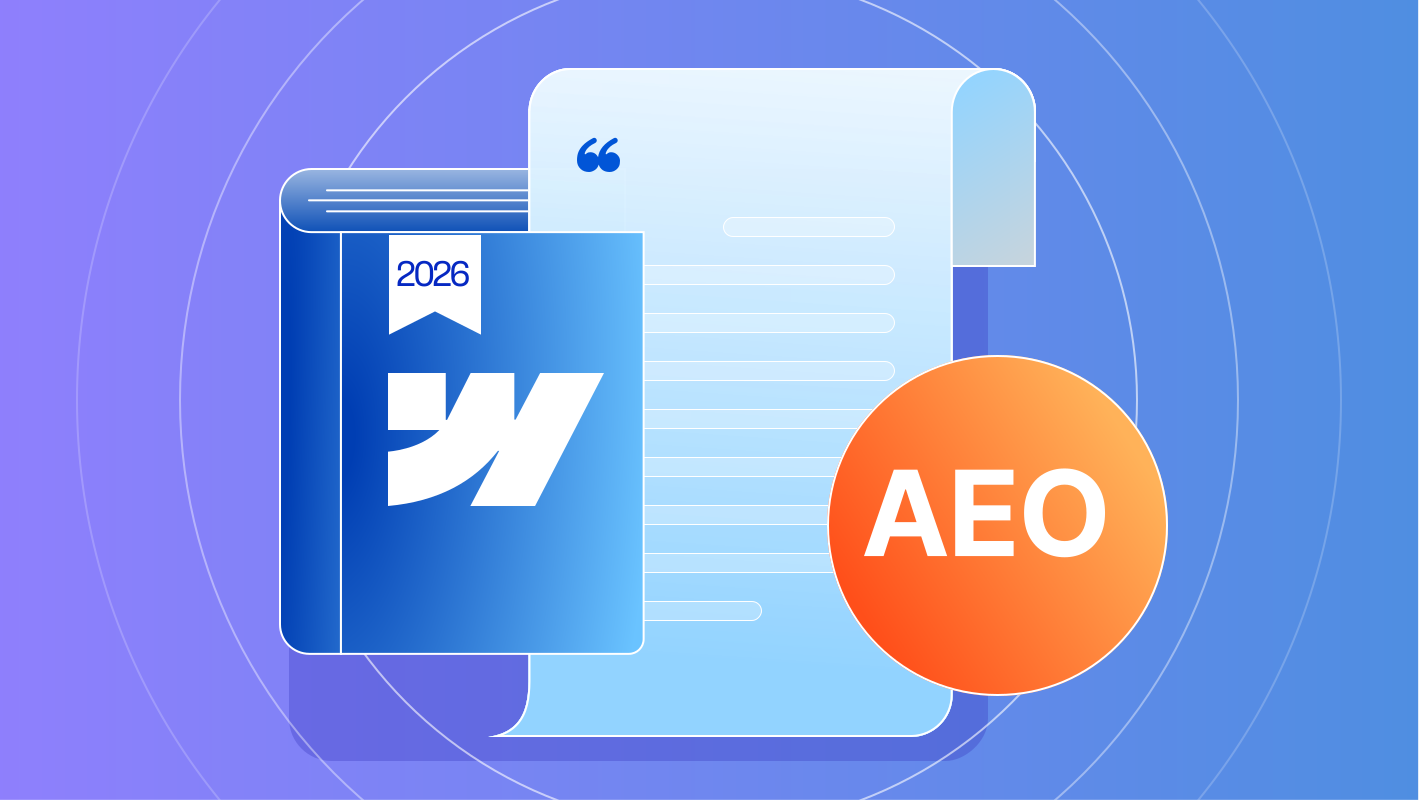

AI agents are no longer whispering at the edges of the buyer journey. They are the buyer journey. Before a human even lands on your homepage, their AI assistant has already scanned your product pages, parsed your case studies, compared you to competitors, and summarized your offering. When they finally arrive on your site, they are not browsing. They are validating.
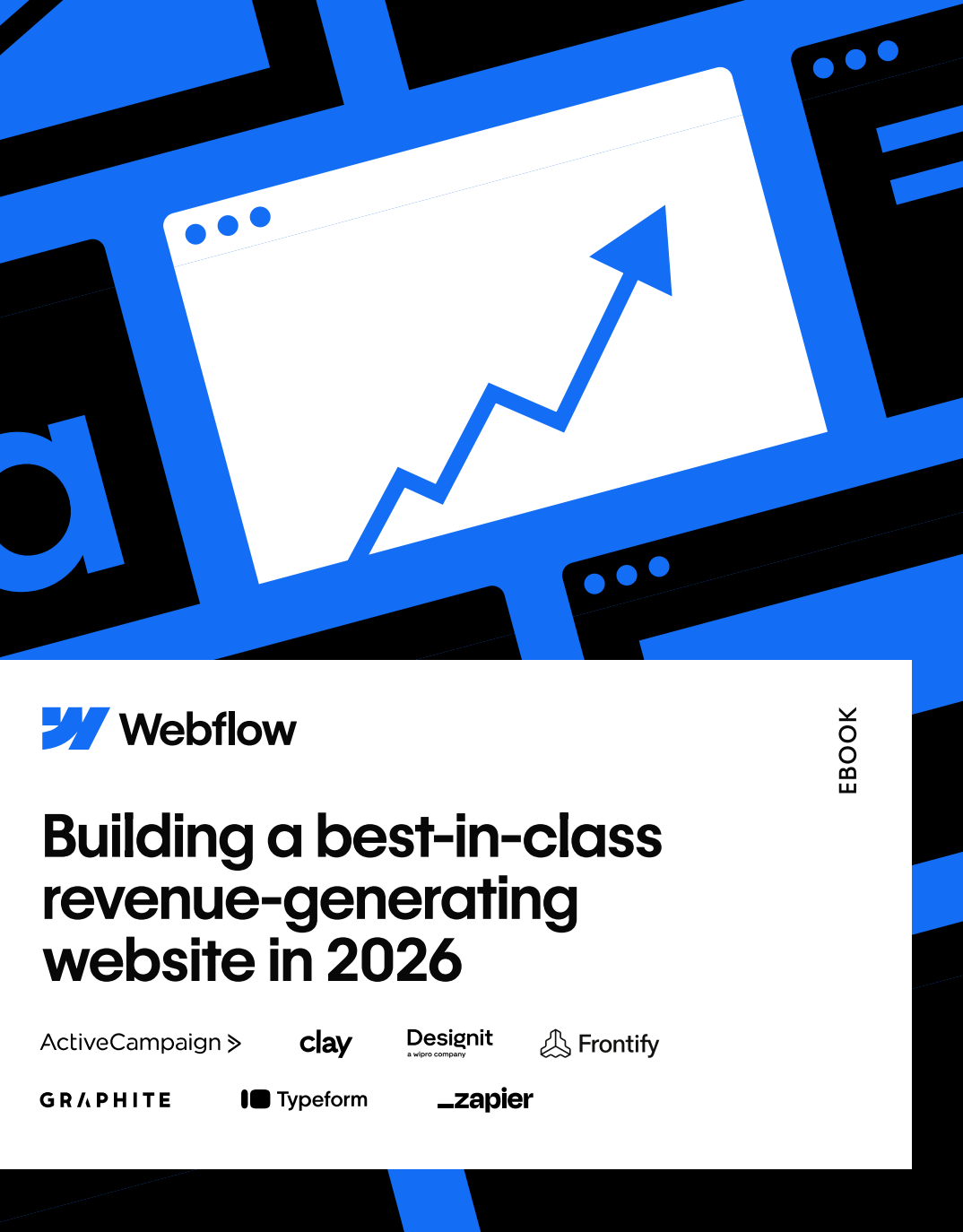
Webflow’s 2026 ebook makes this shift impossible to ignore. The modern website is no longer a destination. It is an interface layer in a larger ecosystem shaped by answer engines, autonomous agents, and visitors who arrive pre-sold or pre-skeptical. Traffic may decrease, but the value of each visit increases. Brands who design for both people and AI systems will win that value. Everyone else drops out of the summaries completely.
Below we unpack Webflow’s most important insights and pair them with what we see inside Composite as a UX design agency and Webflow Enterprise Partner in New York building AI-ready systems for fintech, AI, and high-growth teams.
1. The Buyer Has Changed & Their AI Has Too
One of the clearest signals from Webflow’s ebook is that buyer-side agents now complete much of the research phase before a person enters the picture. These agents read human-facing pages, technical docs, competitor info, reviews, and even industry reports before anyone opens a browser tab.
Webflow notes that an AI assistant may complete 70 to 90 percent of the evaluation process before the human buyer ever visits your website. That changes everything about how a site is designed.
If agents already consumed your content, then the human visit is not the start of the journey. It is the final check. They click through to confirm what their agent summarized. Your site becomes a validation layer. It needs to be fast, structured, scannable, and confident.
This is also why answer-first content, schema, and clarity are not “SEO upgrades” but survival requirements.
Read Designing for AI Agents: How to Structure Content for Machine Interpretation for practical guidance on creating layouts and content patterns that AI models can interpret the way you intend.
2. Why SEO Isn’t Enough: The Move from Search Engines to Answer Engines
SEO still matters, but its job description has changed. Search is no longer the main distribution system. Answer engines are.
Webflow lays this out plainly: AI systems return answers, not links, and they synthesize these answers from multiple sources instead of simply ranking pages.
That means the most important question is no longer how do we rank for this keyword, but how do we become the source an AI trusts enough to cite?
This shift introduces a new hierarchy of needs:
- Structured content beats clever content.
- Clear hierarchies beat long paragraphs.
- Schema beats keyword density.
- Being cited beats being clicked.
Webflow’s ebook also stresses that AEO has a longer tail than SEO. People type short keywords into search. They ask long, complex, conversational questions in AI interfaces.
This is exactly why our own AEO framework has become a core offering across our clients. Brands want to rise in LLM responses, but their content is not built for machine interpretation.
If you're exploring this topic further, check out Credibility in the Age of AI: Where SEO, AEO, UX, and AX Converge for how AI reads authority, structure, and trust across your website.
3. Designing for Humans & Agents at the Same Time
Webflow repeatedly highlights a reality we have discussed at length in our articles: websites must be equally readable by people and machines.
This requirement goes far beyond adding schema. Machines need:
- A clear, consistent content model
- Structured sections
- Predictable hierarchy
- Internal linking that reflects meaning rather than SEO tactics
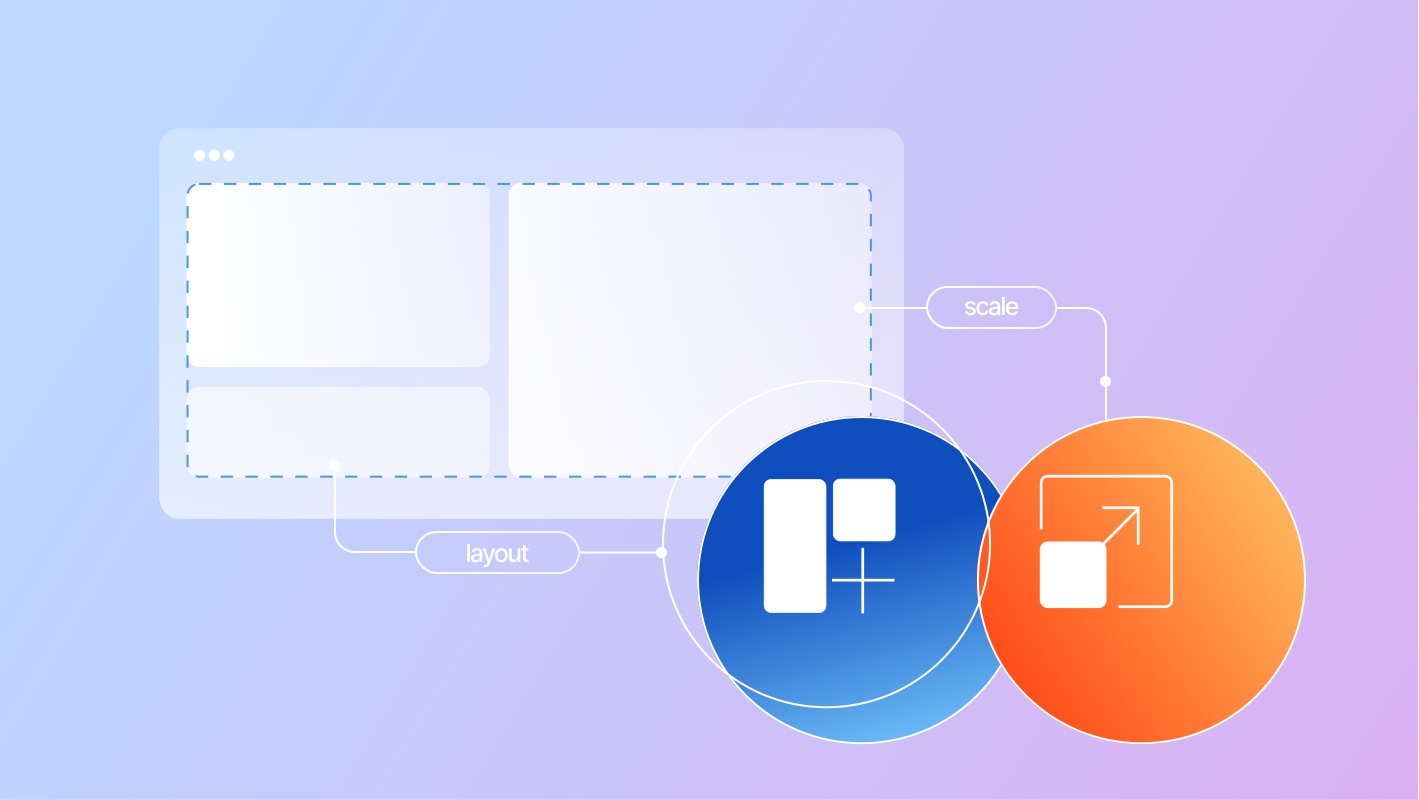
- Component-based layouts instead of one-off pages
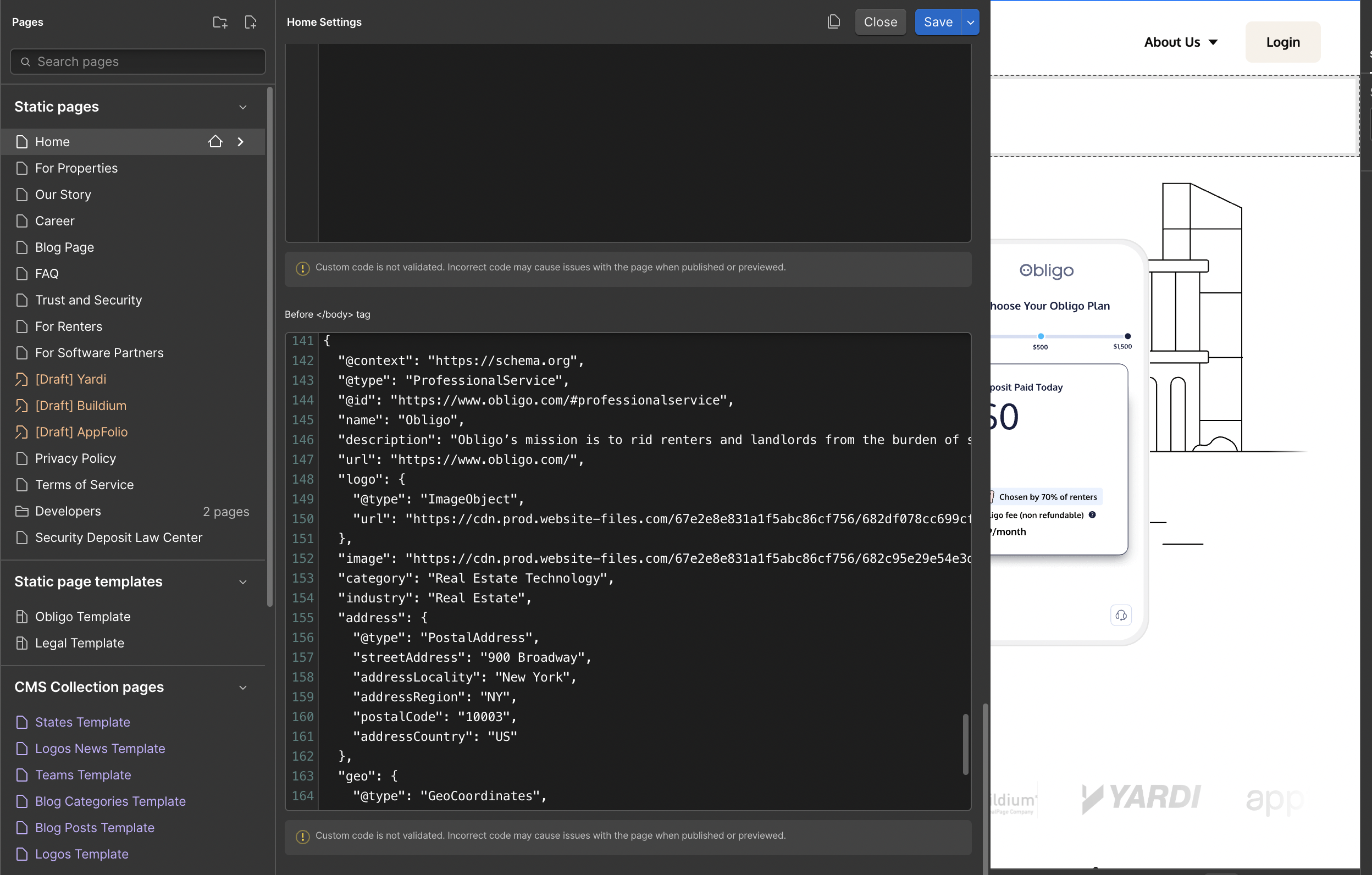
Webflow states that AI agents can only interpret your content accurately when it is structured, definitive, and machine-readable.
At Composite, we see how often this architectural layer becomes the competitive advantage. When a fintech or AI client’s site is modeled with structured content, AI agents understand it immediately. When it isn’t, we watch those brands disappear from agent-generated summaries.
This is where Webflow’s CMS, symbol system, and structured authoring tools give a strong advantage for companies looking for a web design agency to support this transition. The CMS becomes the backbone of both human-facing UX and agent-facing clarity.
4. The New High-Intent Visitor: One Shot to Deliver
If AI agents sell your product before someone sees your homepage, the visitor who finally arrives is high-intent. Webflow outlines this shift clearly: visitors are arriving later in the funnel and expect immediate clarity, performance, and trust signals.
High-intent users have no patience for:
- Slow load times
- Complex navigation
- Vague messaging
- Unclear next steps
- Missing trust markers
- Outdated case studies
- Pages that feel like brochures rather than decision tools
Your website now gets one chance to deliver on the summary the AI agent produced. If your page contradicts it or feels outdated, users bounce. The stakes are higher, but so is the opportunity. A single strong experience becomes the conversion lever.
5. Integration Is Now Your Competitive Advantage
Chapter 8 of Webflow's ebook makes something very clear: websites cannot remain isolated platforms. If your content, CRM, analytics, personalization tools, and automation systems do not speak to each other, AI cannot interpret your site correctly.
Webflow explains that AI agents need access to data and capabilities across the entire stack to personalize and optimize experiences. Siloed stacks fail this requirement. This is where the new Model Context Protocol (MCP) matters. MCP allows AI systems to pull data from CMS tools, analytics systems, CRMs, and automation platforms in standardized ways.
This shifts integration from an enhancement to a foundation. For Composite, this is where Webflow shines. Integrations with tools like Zapier, Clay, Clearbit, ActiveCampaign, and custom APIs allow us to build an ecosystem where:
- AI can understand your content
- Marketing can automate faster
- Personalization becomes predictable
- CRO accelerates continuously
Brands who treat Webflow as the center of an integrated system will outpace competitors who still treat their site as a static brochure.
If you're interested in how AI is changing automation, check out What Zapier’s Latest AI Updates Reveal About the Future of Workflows.
6. AEO, UX, & AX: The New Shape of Digital Strategy
Webflow focuses heavily on SEO and AEO, but this is only part of the picture. What emerges across their ebook aligns closely with Composite’s broader framework:
- AEO helps AI interpret your content
- UX helps humans navigate it
- AX (agent experience) helps AI extract meaning from your structure
If your site only works for one of these audiences, you lose visibility, and the brands that thrive will support all three.
This is why Composite sees the role of UX shifting. We increasingly act as an AI-readiness partner helping organizations structure content for both humans and autonomous systems.
Where UX Goes Next
Webflow’s 2026 ebook makes something unmistakable. The modern website is a system, a data layer, a structured knowledge source, a relationship validator, a machine interface, and a human experience.
It is no longer enough to optimize for clicks. The job now is visibility inside AI systems, clarity for high-intent visitors, and structured content that can be parsed, cited, and trusted.
Designing for this new reality requires teams to think beyond SEO and beyond aesthetics. The websites that win in 2026 will be those that treat structure as strategy, clarity as credibility, and integration as the multiplier that ties everything together.
The buyer journey has changed. The website has changed. And the brands that adapt will earn the advantage before their competitors even realize the rules have shifted.
.svg)
.svg)